
Saber and conhecer are two Portuguese verbs that confuse a lot of learners, because in English both can be translated as to know. With saber and conhecer, the general rule is simple: saber is for facts, information and skills, and conhecer is for people, places and things you are familiar with. (Saber = to know something or how to do something; conhecer = to be familiar with someone or something.)
In this post about saber and conhecer in the present indicative, you will see the conjugation of both verbs, learn when to use each one, discover everyday expressions, listen to 14 sentences and practice with 24 exercises. Ready?
See how we use saber and conhecer
- Eu sei cozinhar. (I know how to cook.)
- Você conhece o meu irmão? (Do you know my brother?)
- Ela sabe o endereço da escola. (She knows the school’s address.)
- Nós conhecemos Salvador. (We have been to Salvador.)
- Eles não sabem a resposta. (They don’t know the answer.)
Activity 1
Drag the words to complete the sentences.
Eu *sei* tocar violão.
Você *conhece* o professor novo?
Nós *sabemos* o caminho.
Eu *conheço* um restaurante ótimo.
Elas *sabem* falar francês.
A gente *conhece* Florianópolis.
O Pedro *sabe* a data da festa.
Meus avós *conhecem* a Bahia.
How to conjugate saber and conhecer in the present indicative
Which present? Here, presente do indicativo (present indicative) is the tense we use for what is happening now, what always happens and facts. (In English, it matches the simple present.)
| Pronome (Pronoun) | Saber | Conhecer |
|---|---|---|
| Eu (I) | sei Eu sei o seu nome. (I know your name.) | conheço Eu conheço a sua irmã. (I know your sister.) |
| Você, Ele, Ela (You, He, She) | sabe Ela sabe nadar. (She can swim.) | conhece Ela conhece o Rio. (She knows Rio.) |
| A gente (We – informal) | sabe A gente sabe o caminho. (We know the way.) | conhece A gente conhece a cidade. (We know the city.) |
| Nós (We – formal) | sabemos Nós sabemos a resposta. (We know the answer.) | conhecemos Nós conhecemos esse restaurante. (We know this restaurant.) |
| Vocês, Eles, Elas (You all, They) | sabem Eles sabem que ela mora aqui. (They know she lives here.) | conhecem Eles conhecem a professora. (They know the teacher.) |
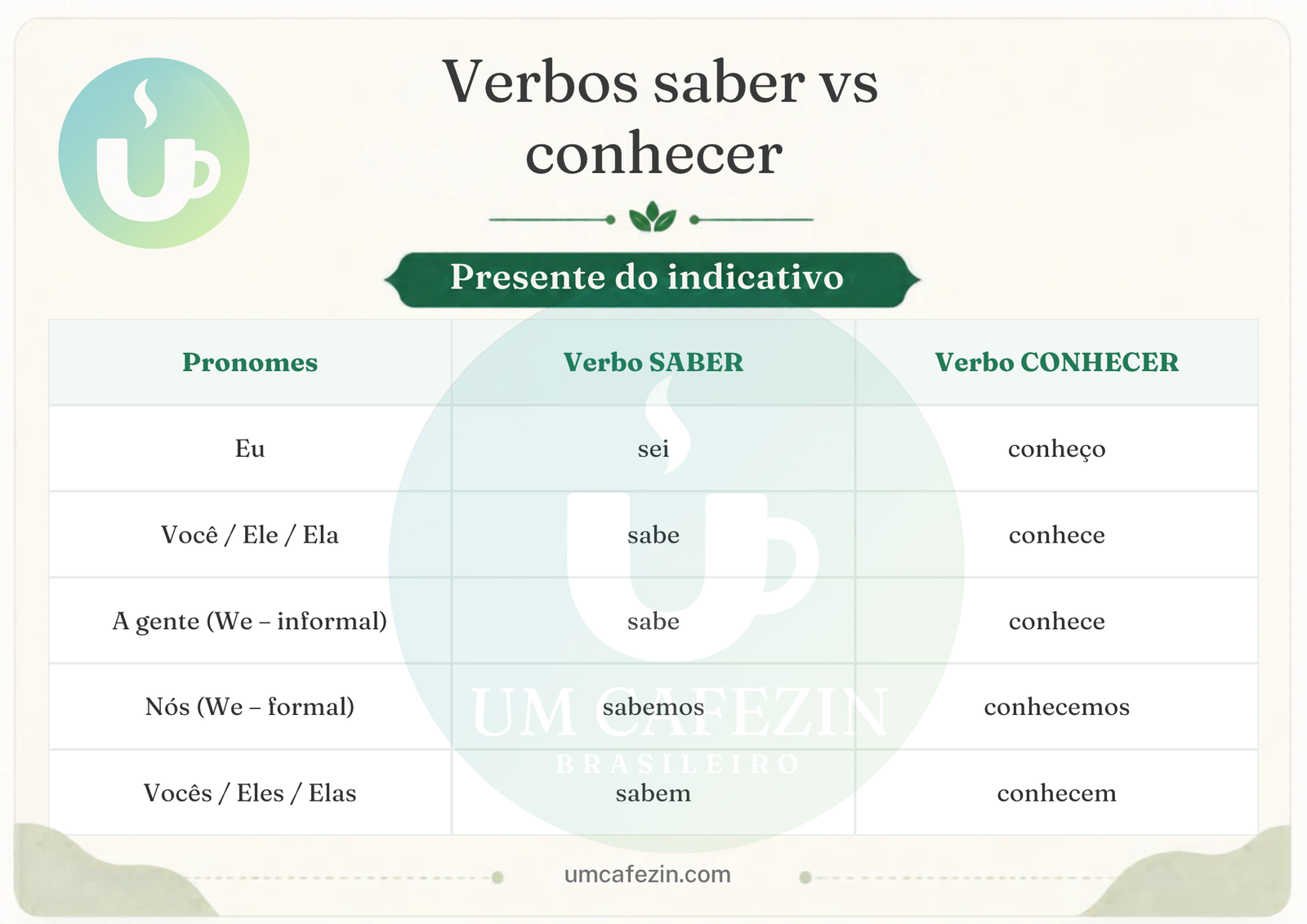
Remember: saber is irregular only in the “eu” form: sei. The other forms follow the pattern: sabe, sabemos, sabem. Conhecer is regular. Only the spelling changes with “eu”: conheço, with ç, to keep the “s” sound.
Tip: to make a negative sentence, put não before the verb: Eu não sei. (I don’t know.) To ask a question, the word order does not change. Only your intonation changes: Você conhece essa música? (Do you know this song?) To answer “yes”, repeat the verb: Conheço. (Yes, I do.)
When to use saber and conhecer
| Saber | Conhecer |
|---|---|
| Facts and information: Eu sei o seu telefone. (I know your phone number.) | People: Eu conheço a Ana. (I know Ana.) |
| Skills (saber + infinitive): Ela sabe cozinhar. (She knows how to cook.) | Places: Nós conhecemos Recife. (We have been to Recife.) |
| Saber + que: Eu sei que ele mora aqui. (I know that he lives here.) | Things you have seen or used: Você conhece esse restaurante? (Are you familiar with this restaurant?) |
| Saber + onde, quem, como, quando: Você sabe onde fica o banco? (Do you know where the bank is?) | Seeing or visiting for the first time: Eu quero conhecer o Brasil. (I want to visit Brazil.) |
Tip: to choose between saber and conhecer, look at what comes after the verb. If it is a person, a place or a thing, use conhecer. If it is a verb in the infinitive, “que” (that) or a question word (onde, quem, como, quando), use saber.
Note: in English, “can” is often the best translation of saber + infinitive: Ela sabe nadar. (She can swim.) And with places, conhecer often means “to have been to”: Eu conheço Lisboa. (I have been to Lisbon.)
Same situation, different meanings
Sometimes saber and conhecer appear in the same situation, but with different meanings:
| Assunto (Topic) | Saber | Conhecer |
|---|---|---|
| Pessoa (Person) | Eu sei quem é a Ana. (I know who Ana is.) | Eu conheço a Ana. (I know Ana personally.) |
| Lugar (Place) | Eu sei onde fica o museu. (I know where the museum is.) | Eu conheço o museu. (I have been to the museum.) |
| Música (Song) | Eu sei a letra desta música. (I know the lyrics of this song.) | Eu conheço esta música. (I’m familiar with this song.) |
Everyday expressions
Many everyday expressions use saber and conhecer:
| Expressão (Expression) | Exemplo (Example) |
|---|---|
| Sei lá! | Onde está o Pedro? – Sei lá! (Where is Pedro? – No idea!) |
| …, sabe? | Estou cansada, sabe? (I’m tired, you know?) |
| Que eu saiba… | Que eu saiba, a loja abre às nove. (As far as I know, the store opens at nine.) |
| Prazer em conhecer! | Oi, Marta! Prazer em conhecer você! (Hi, Marta! Nice to meet you!) |
Careful: “Sei lá!” is informal. In a formal situation, say “Não sei” (I don’t know).
Useful questions with saber and conhecer
You will hear these questions with saber and conhecer a lot when you talk with Brazilians:
| Pergunta (Question) | Resposta (Answer) |
|---|---|
| Você sabe falar português? (Can you speak Portuguese?) | Sei um pouco. |
| Você sabe onde fica o banheiro? (Do you know where the bathroom is?) | Sei, sim. É ali. |
| Você conhece o Brasil? (Have you been to Brazil?) | Conheço pouco. |
| Você conhece essa música? (Do you know this song?) | Conheço, sim. |
Sentences with saber and conhecer to listen to
Tap the green button to hear each sentence. Use “Modo teste” (test mode) to hide the English and practice.
Part 1 • Saber
| Português | English |
|---|---|
| Eu sei o número da Carla. | I know Carla’s number. |
| Você sabe que horas são? | Do you know what time it is? |
| Meu filho sabe ler. | My son can read. |
| Vocês sabem dirigir? | Can you drive? |
| A gente sabe que a prova é difícil. | We know the test is hard. |
| Ninguém sabe onde está a chave. | Nobody knows where the key is. |
| Eu conheço o dono da padaria. | I know the bakery owner. |
Part 2 • Conhecer and expressions
| Português | English |
|---|---|
| Você conhece a minha namorada? | Have you met my girlfriend? |
| Nós conhecemos bem o Nordeste. | We know the Northeast well. |
| Eles ainda não conhecem São Paulo. | They haven’t been to São Paulo yet. |
| A Júlia conhece um bom dentista. | Júlia knows a good dentist. |
| Quero conhecer a sua cidade. | I want to visit your city. |
| Sei lá! | No idea! |
| Muito prazer em conhecer você! | Very nice to meet you! |
Common mistakes with saber and conhecer
English speakers often mix up saber and conhecer, because English uses “to know” for both. Here are the four most common mistakes:
- For people, we use conhecer.
- ❌ Eu sei a Ana. → ✅ Eu conheço a Ana. (I know Ana.)
- For skills, we use saber.
- ❌ Eu conheço nadar. → ✅ Eu sei nadar. (I can swim.)
- With “eu”, saber becomes “sei”.
- ❌ Eu sabo. → ✅ Eu sei. (I know.)
- Before onde, quem, como and quando, we use saber.
- ❌ Você conhece onde fica o banco? → ✅ Você sabe onde fica o banco? (Do you know where the bank is?)
Activity 2
Complete the sentences with saber or conhecer in the present indicative.
Eu não *sei* o nome dela. (saber)
Você *conhece* o Museu do Ipiranga? (conhecer)
Nós *sabemos* fazer arroz. (saber)
Eu *conheço* a mãe do Lucas. (conhecer)
Vocês *sabem* que dia é hoje? (saber)
Elas *conhecem* bem a cidade. (conhecer)
A gente *sabe* nadar. (saber)
Os turistas não *conhecem* o bairro. (conhecer)
Activity 3
Choose the correct option.
Eu ___ a irmã do Paulo.
- conheço
- sei
- sabe
- conhece
Para pessoas, usamos conhecer.
Você ___ onde fica a estação?
- sabe
- conhece
- sei
- conheço
Antes de onde, quem, como e quando, usamos saber.
Ela ___ dançar samba.
- sabe
- conhece
- conheço
- sei
Para habilidades (saber + infinitivo), usamos saber.
Qual frase está correta?
- Eu conheço o Rio de Janeiro.
- Eu sei o Rio de Janeiro.
- Eu sabo o Rio de Janeiro.
- Eu conhece o Rio de Janeiro.
Para lugares, usamos conhecer.
Qual é a forma de saber com “eu”?
- sei
- sabo
- sabe
- saibo
Saber é irregular com eu: eu sei.
Como dizemos “Nice to meet you”?
- Prazer em conhecer você.
- Prazer em saber você.
- Prazer de saber você.
- Prazer conhecer você.
Nós ___ que você está cansado.
- sabemos
- conhecemos
- sabem
- conhecem
Antes de que + frase, usamos saber.
Eles ___ um bom hotel no centro.
- conhecem
- sabem
- conhecemos
- sabe
Frequently asked questions
Are saber and conhecer irregular verbs?
Saber is irregular: in the present indicative, only the “eu” form changes (sei). Conhecer is regular; only the spelling changes with “eu” (conheço, with ç). You can look up both verbs in the Michaelis Online dictionary (in Portuguese).
Can I say “eu sei a Ana”?
No. For people, we use conhecer: “Eu conheço a Ana.” If you only know a fact about her, say “Eu sei quem é a Ana” (I know who Ana is).
How do I say “I don’t know” in Portuguese?
We say “Não sei”. In informal speech, “Sei lá!” (No idea!) is also very common.
“Eu sei nadar” or “eu posso nadar”?
It depends on the meaning. “Eu sei nadar” is about a skill you learned (I can swim / I know how to swim). “Eu posso nadar” is about permission or possibility: “Hoje eu posso nadar, porque a piscina está aberta.” (I can swim today, because the pool is open.)
Does conhecer also mean “to meet”?
Yes, when it is the first time: “Quero conhecer os seus pais.” (I want to meet your parents.) That is why we say “Prazer em conhecer você!” (Nice to meet you!)
Hora do Cafezinho
Let’s practice saber and conhecer! Answer out loud or write in your notebook: O que você sabe fazer bem? Que cidades do Brasil você conhece? Você sabe o nome dos seus vizinhos? (What can you do well? Which cities in Brazil have you been to? Do you know your neighbors’ names?) Example: “Eu sei cozinhar e sei tocar violão. Conheço São Paulo, mas ainda não conheço o Rio.” (I know how to cook and I can play the guitar. I have been to São Paulo, but I haven’t been to Rio yet.)
Worksheet – PDF
Activities with an answer key to print (in Portuguese).