
Regular -AR verbs are the easiest and most common group of verbs in Portuguese: falar, trabalhar, estudar, morar and many others. Once you learn to conjugate regular -AR verbs, you can already talk about your home, your job and your daily routine. (Falar = to speak; trabalhar = to work; estudar = to study; morar = to live.)
In this post about regular -AR verbs in the present indicative, you will see the endings, the list of the 16 most common verbs, the most common mistakes, listen to 14 sentences and practice with 24 exercises. Ready?
See how we use regular -AR verbs
- Eu trabalho num banco. (I work at a bank.)
- Você fala português? (Do you speak Portuguese?)
- A Marta mora em Curitiba. (Marta lives in Curitiba.)
- Nós estudamos juntos. (We study together.)
- Eles esperam o ônibus. (They are waiting for the bus.)
Activity 1
Drag the words to complete the sentences.
Eu *canto* no chuveiro.
Você *ajuda* a sua mãe?
Ela *espera* o metrô.
Nós *levamos* as crianças para a escola.
Eles *conversam* muito.
A gente *almoça* ao meio-dia.
Vocês *usam* o computador todo dia?
O Pedro *paga* a conta.
How to conjugate regular -AR verbs in the present indicative
Which present? Here, presente do indicativo (present indicative) is the tense we use for what is happening now, what always happens and facts. (In English, it matches the simple present.)
The rule has two steps. First, remove the -ar from the infinitive: falar → fal-. Then add the ending for each person:
| Pronome (Pronoun) | Terminação (Ending) | Falar | Exemplo (Example) |
|---|---|---|---|
| Eu (I) | -o | falo | Eu falo devagar. (I speak slowly.) |
| Você, Ele, Ela (You, He, She) | -a | fala | Ela fala três línguas. (She speaks three languages.) |
| A gente (We – informal) | -a | fala | A gente fala ao telefone. (We talk on the phone.) |
| Nós (We – formal) | -amos | falamos | Nós falamos com o professor. (We talk to the teacher.) |
| Vocês, Eles, Elas (You all, They) | -am | falam | Eles falam rápido. (They speak fast.) |
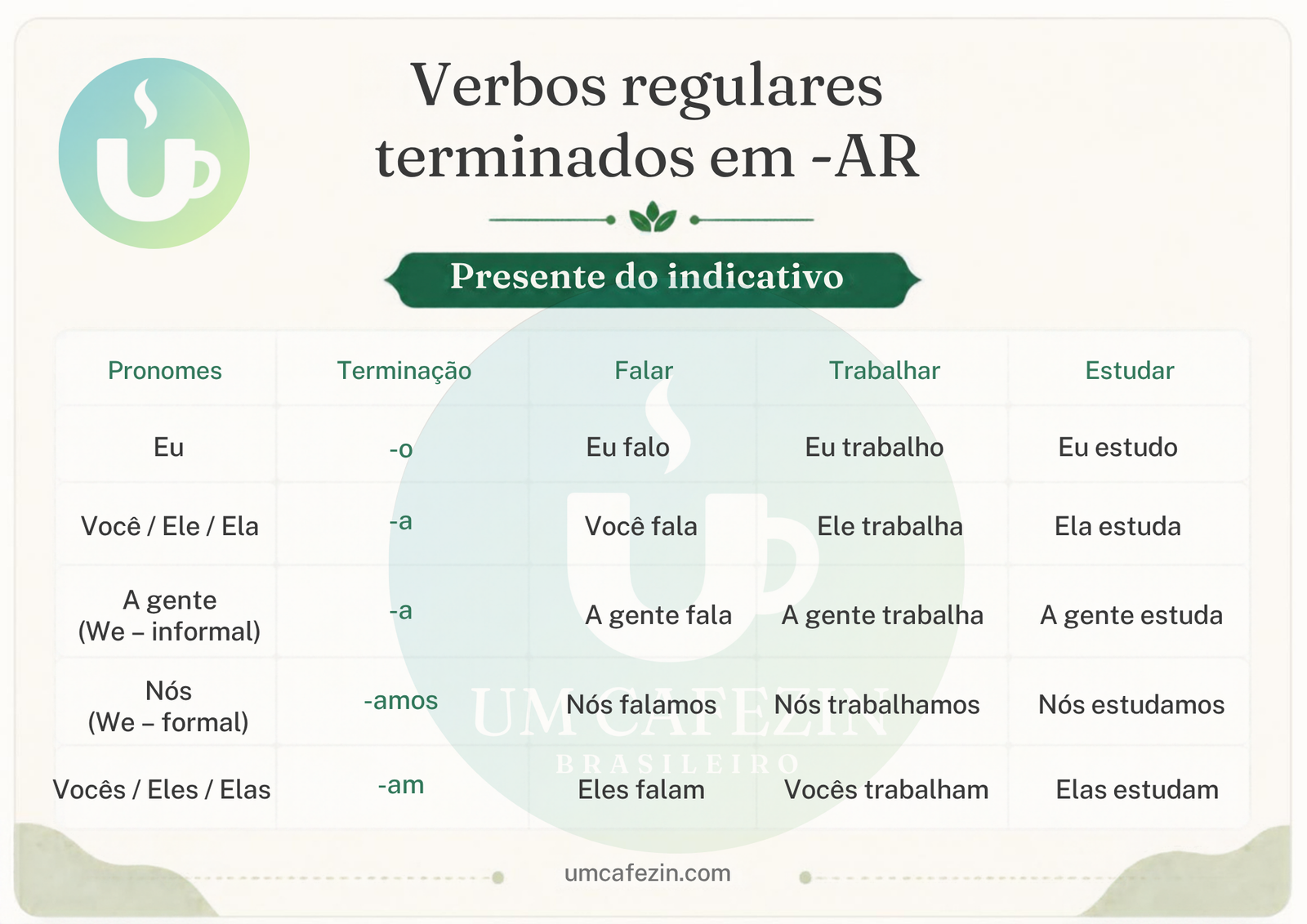
Remember: the endings are always the same: -o, -a, -amos, -am. Você, ele, ela and a gente share the same form (fala). In Brazilian Portuguese, the “nós” form is the same in the present and in the simple past: “nós falamos” can mean we speak or we spoke. The context shows the tense.
Tip: to make a negative sentence, put não before the verb: Eu não trabalho amanhã. (I don’t work tomorrow.) To ask a question, the word order does not change. Only your intonation changes: Você mora aqui? (Do you live here?) To answer “yes”, repeat the verb: Moro. (Yes, I do.)
The most common regular -AR verbs
These 16 regular -AR verbs come up in conversations every day. All of them follow the rule in the table.
| Verbo (Verb) | English | Exemplo (Example) |
|---|---|---|
| falar | to speak, to talk | A professora fala devagar. (The teacher speaks slowly.) |
| trabalhar | to work | Meu irmão trabalha num hospital. (My brother works at a hospital.) |
| estudar | to study | Eu estudo português com música. (I study Portuguese with music.) |
| morar | to live | Meus pais moram no interior. (My parents live in the countryside.) |
| gostar (de) | to like | Você gosta de futebol? (Do you like soccer?) |
| comprar | to buy | Nós compramos frutas na feira. (We buy fruit at the street market.) |
| cozinhar | to cook | Eu cozinho no fim de semana. (I cook on the weekend.) |
| ajudar | to help | Os vizinhos ajudam a gente. (The neighbors help us.) |
| chegar | to arrive | Ela sempre chega atrasada. (She always arrives late.) |
| viajar | to travel | Vocês viajam muito? (Do you travel a lot?) |
| andar | to walk | Nós andamos na praia de manhã. (We walk on the beach in the morning.) |
| esperar | to wait, to hope | Eu espero você na porta. (I’ll wait for you at the door.) |
| tomar | to take, to drink | Ela toma remédio de manhã. (She takes medicine in the morning.) |
| precisar (de) | to need | Eu preciso de um café. (I need a coffee.) |
| acordar | to wake up | A gente acorda às seis. (We wake up at six.) |
| jantar | to have dinner | Eles jantam tarde. (They have dinner late.) |
Careful: not every verb ending in -ar is regular. Estar (estou, está, estamos, estão) and dar (dou, dá, damos, dão) are irregular. Verbs ending in -ear, like passear (to go for a walk), add an “i” in some forms: eu passeio, ela passeia, nós passeamos, eles passeiam.
Verbs that take a preposition
Some regular -AR verbs need a preposition before the object, even when English does not use one. See the examples below:
| Verbo + preposição (Verb + preposition) | Exemplo (Example) |
|---|---|
| gostar de | Eu gosto de chocolate. (I like chocolate.) |
| precisar de | Ela precisa de um médico. (She needs a doctor.) |
| morar em | Nós moramos em Belo Horizonte. (We live in Belo Horizonte.) |
| conversar com | Eu converso com a minha avó. (I talk with my grandmother.) |
| pensar em | Você pensa em morar no Brasil? (Are you thinking about living in Brazil?) |
Sentences with regular -AR verbs to listen to
Tap the green button to hear each sentence. Use “Modo teste” (test mode) to hide the English and practice.
Part 1 • Home, work and study
| Português | English |
|---|---|
| Eu falo inglês e espanhol. | I speak English and Spanish. |
| Você trabalha em casa? | Do you work from home? |
| Ela estuda à noite. | She studies at night. |
| Nós moramos perto da praia. | We live near the beach. |
| A gente gosta de café forte. | We like strong coffee. |
| Eles compram pão todos os dias. | They buy bread every day. |
| Meu pai cozinha muito bem. | My father cooks very well. |
Part 2 • Routine and daily life
| Português | English |
|---|---|
| Vocês precisam de ajuda? | Do you need help? |
| O ônibus chega às sete. | The bus arrives at seven. |
| Eu acordo cedo durante a semana. | I wake up early during the week. |
| Nós jantamos às oito. | We have dinner at eight. |
| Eles não viajam no inverno. | They don’t travel in the winter. |
| Você toma café com leite? | Do you drink coffee with milk? |
| Eu ando de bicicleta no parque. | I ride my bike in the park. |
Common mistakes with regular -AR verbs
These are the four mistakes learners make most often with regular -AR verbs:
- With “eu”, the ending is -o.
- ❌ Eu fala inglês. → ✅ Eu falo inglês. (I speak English.)
- With “a gente”, the verb takes the same form as “ele” and “ela”.
- ❌ A gente estudamos. → ✅ A gente estuda. (We study.)
- With “eles” and “elas”, the ending is -am.
- ❌ Eles trabalhamos aqui. → ✅ Eles trabalham aqui. (They work here.)
- Gostar and precisar need the preposition “de”.
- ❌ Eu preciso um táxi. → ✅ Eu preciso de um táxi. (I need a taxi.)
Activity 2
Complete the sentences with the verb in the present indicative. The infinitive is in parentheses.
Eu *lavo* a louça depois do jantar. (lavar)
Você *mora* sozinho? (morar)
Nós *dançamos* forró. (dançar)
Elas *estudam* medicina. (estudar)
A gente *passa* as férias na Bahia. (passar)
Meu irmão *fala* alto. (falar)
Vocês *trabalham* aos sábados? (trabalhar)
Eu não *gosto* de chuva. (gostar)
Activity 3
Choose the correct option.
Eu ___ português todos os dias.
- falo
- fala
- falamos
- falam
Com eu, a terminação é -o.
Elas ___ em São Paulo.
- moram
- mora
- moramos
- moro
Com eles e elas, a terminação é -am.
A gente ___ cedo.
- acorda
- acordamos
- acordam
- acordo
Com a gente, o verbo fica igual ao de você, ele e ela.
Qual frase está correta?
- Eu gosto de música.
- Eu gosto música.
- Eu gosta de música.
- Eu gostamos de música.
Gostar pede a preposição de.
Qual destes verbos não é regular?
- estar
- falar
- morar
- estudar
Estar termina em -ar, mas é irregular: estou, está, estamos, estão.
Nós ___ a aula às nove.
- começamos
- começam
- começa
- começo
Com nós, a terminação é -amos.
Você ___ de ajuda?
- precisa
- preciso
- precisam
- precisamos
Com você, a terminação é -a.
Qual é a terminação de eles nos verbos regulares em -ar?
- -am
- -a
- -amos
- -o
Frequently asked questions
Are all verbs ending in -ar regular?
No. Most verbs ending in -ar are regular -AR verbs, but estar and dar are irregular, and verbs ending in -ear (passear, passeio) change in some forms. When in doubt, check the conjugation in the Michaelis Online dictionary (in Portuguese).
Is “nós falamos” present or past?
It can be both. With regular -AR verbs, the “nós” form is the same in the present and in the simple past: “Nós falamos português todo dia” (We speak Portuguese every day) and “Ontem nós falamos com ela” (Yesterday we spoke with her). Words like “todo dia” and “ontem” show the tense.
What is the difference between “a gente fala” and “nós falamos”?
The meaning is the same: we speak. “A gente” is more common in everyday speech and uses the “ele” form (fala). “Nós” is a bit more formal and uses the -amos ending (falamos).
How do I say “I am speaking” in Portuguese?
Use the verb estar + the verb ending in -ando: “Eu estou falando com a minha mãe.” (I am speaking with my mother.) With regular -AR verbs, just change -ar to -ando: falar → falando, trabalhar → trabalhando.
Do -er and -ir verbs follow the same rule?
The idea is the same: remove the infinitive ending and add a new one. But the endings are different (como, come, comemos, comem). Start with regular -AR verbs, because they are the biggest group.
Hora do Cafezinho
Let’s practice regular -AR verbs! Answer out loud or write in your notebook:
- Onde você mora? (Where do you live?)
- Você trabalha ou estuda? (Do you work or study?)
- A que horas você acorda e janta? (What time do you wake up and have dinner?)
Example: “Eu moro em Lisboa. Trabalho numa escola e estudo português à noite. Acordo às sete e janto às oito.” (I live in Lisbon. I work at a school and study Portuguese at night. I wake up at seven and have dinner at eight.)
Worksheet – PDF
Activities with an answer key to print (in Portuguese).