
The verb ter is one of the most used verbs in Portuguese. It means “to have”, and we use it to talk about what we own, age, family, feelings like hunger and cold, appointments and obligations. It is irregular: eu tenho, você tem, nós temos, eles têm. (I have, you have, we have, they have.)
In this post about the verb ter in the present indicative, you will see the conjugation, understand the difference between “tem” and “têm”, learn the most common uses, like “ter que” and “tem” meaning “there is”, listen to 14 sentences and practice with 24 exercises. Ready?
See how we use the verb ter
- Eu tenho dois gatos. (I have two cats.)
- Você tem tempo hoje? (Do you have time today?)
- Ela tem 28 anos. (She is 28 years old.)
- Nós temos aula às oito. (We have class at eight.)
- Eles têm muitos amigos no Brasil. (They have a lot of friends in Brazil.)
Activity 1
Drag the words to complete the sentences.
Eu *tenho* uma casa pequena.
O Marcos *tem* um cachorro grande.
Nós *temos* prova na sexta.
Meus pais *têm* uma loja.
Você *tem* caneta?
A gente *tem* reunião às dez.
Elas *têm* cabelo cacheado.
Eu *tenho* trinta anos.
How to conjugate the verb ter in the present indicative
Which present? Here, presente do indicativo (present indicative) is the tense we use for what is happening now, what always happens and facts. (In English, it matches the simple present.)
| Pronome (Pronoun) | Verbo ter | Exemplo (Example) |
|---|---|---|
| Eu (I) | tenho | Eu tenho um irmão. (I have a brother.) |
| Você, Ele, Ela (You, He, She) | tem | Ela tem uma reunião hoje. (She has a meeting today.) |
| A gente (We – informal) | tem | A gente tem tempo. (We have time.) |
| Nós (We – formal) | temos | Nós temos um carro novo. (We have a new car.) |
| Vocês, Eles, Elas (You all, They) | têm | Eles têm duas casas. (They have two houses.) |
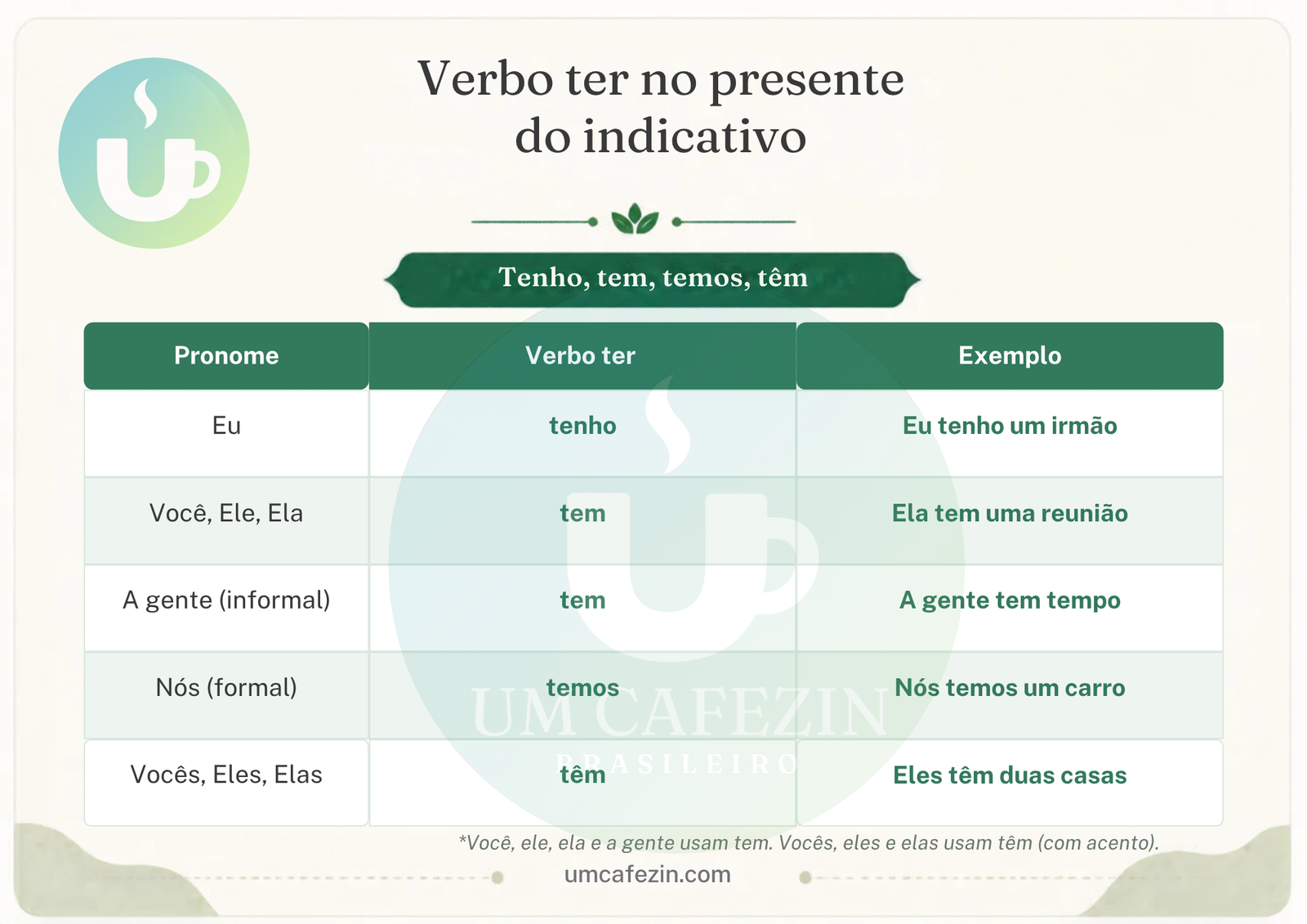
Remember: the verb ter is irregular. The forms are tenho, tem, temos, têm. Você, ele, ela and a gente use tem, with no accent. Vocês, eles and elas use têm, with a circumflex accent. In Brazil, both forms sound the same: the difference is only in writing.
Tip: to make a negative sentence, put não before the verb: Eu não tenho carro. (I don’t have a car.) To ask a question, the word order does not change. Only your intonation changes: Você tem irmãos? (Do you have siblings?) To answer “yes”, repeat the verb: Tenho. (Yes, I do.)
When to use the verb ter
| Uso (Use) | Exemplo (Example) |
|---|---|
| Possession | Eu tenho um celular novo. (I have a new phone.) |
| Age | O meu filho tem dez anos. (My son is ten years old.) |
| Family | A Rita tem duas irmãs. (Rita has two sisters.) |
| Feelings (fome, sede, sono, frio, calor, medo) | Eu tenho sono à tarde. (I get sleepy in the afternoon.) |
| Pain and illness | Ele tem dor nas costas. (He has back pain.) |
| Appointments | Nós temos dentista na terça. (We have a dentist appointment on Tuesday.) |
| Obligation (ter que + infinitive) | Eu tenho que trabalhar amanhã. (I have to work tomorrow.) |
| Existence (tem = há) | Tem um mercado perto daqui. (There’s a market near here.) |
Note: for age, Portuguese uses the verb ter (“to have”), not ser or estar: Eu tenho 25 anos. (I am 25 years old.) The same goes for feelings: Eu tenho fome. (I am hungry.)
Tem = há (there is, there are)
In everyday speech, Brazilians use tem to mean there is and there are. In formal writing, we use há (from the verb haver).
| In speech | In formal writing |
|---|---|
| Tem um café aqui perto. (There’s a café near here.) | Há um café aqui perto. |
| Tem muitas pessoas na fila. (There are a lot of people in line.) | Há muitas pessoas na fila. |
Tip: with this meaning, “tem” does not change in the plural: Tem dois bancos aqui, not “têm dois bancos aqui”.
Expressions with the verb ter
| Expressão (Expression) | Exemplo (Example) |
|---|---|
| Não tem de quê. | Obrigada! – Não tem de quê. (Thank you! – You’re welcome.) |
| ter razão | Você tem razão. (You’re right.) |
| ter saudade | Eu tenho saudade da minha família. (I miss my family.) |
| ter vontade de | Tenho vontade de comer pizza. (I feel like eating pizza.) |
Useful questions with the verb ter
| Pergunta (Question) | Resposta (Answer) |
|---|---|
| Quantos anos você tem? (How old are you?) | Tenho 25 anos. |
| Você tem irmãos? (Do you have siblings?) | Tenho, sim. Tenho dois irmãos. |
| Você tem WhatsApp? (Do you have WhatsApp?) | Tenho. Qual é o seu número? |
| Tem banheiro aqui? (Is there a bathroom here?) | Tem, sim. Ali no fundo. |
Sentences with the verb ter to listen to
Tap the green button to hear each sentence. Use “Modo teste” (test mode) to hide the English and practice.
Part 1 • Possession, age and feelings
| Português | English |
|---|---|
| Eu tenho uma bicicleta azul. | I have a blue bike. |
| Minha avó tem oitenta anos. | My grandmother is eighty years old. |
| Você tem filhos? | Do you have children? |
| Nós temos três sobrinhos. | We have three nephews. |
| Eu tenho sede depois da academia. | I’m thirsty after the gym. |
| As crianças têm medo do escuro. | The children are afraid of the dark. |
| O Paulo tem dor de dente. | Paulo has a toothache. |
Part 2 • Appointments, obligations and expressions
| Português | English |
|---|---|
| A gente tem consulta amanhã. | We have a doctor’s appointment tomorrow. |
| Vocês têm aula de inglês hoje? | Do you have English class today? |
| Eu tenho que acordar cedo. | I have to wake up early. |
| Ela tem que pagar a conta. | She has to pay the bill. |
| Tem uma farmácia na esquina. | There’s a pharmacy on the corner. |
| Não tem problema! | No problem! |
| Eu não tenho tempo agora. | I don’t have time now. |
Common mistakes with the verb ter
- With “eu”, we use “tenho”.
- ❌ Eu tem um carro. → ✅ Eu tenho um carro. (I have a car.)
- With “eles” and “elas”, we write “têm”, with an accent.
- ❌ Eles tem duas casas. → ✅ Eles têm duas casas. (They have two houses.)
- For age, we use the verb ter, not ser.
- ❌ Eu sou 25 anos. → ✅ Eu tenho 25 anos. (I am 25 years old.)
- When “tem” means “there is/are”, it does not change in the plural.
- ❌ Têm dois bancos aqui. → ✅ Tem dois bancos aqui. (There are two banks here.)
Activity 2
Complete the sentences with the verb ter in the present indicative.
Eu *tenho* frio no inverno. (ter)
A Lúcia *tem* três irmãs. (ter)
Nós *temos* que estudar mais. (ter)
Os alunos *têm* muitas perguntas. (ter)
Você *tem* febre? (ter)
Eu não *tenho* carro. (ter)
A gente *tem* uma viagem em março. (ter)
Vocês *têm* horário livre amanhã? (ter)
Activity 3
Choose the correct option.
Eu ___ dois irmãos.
- tenho
- tem
- temos
- têm
Eles ___ uma casa na praia.
- têm
- tem
- tenho
- temos
Com eles e elas, escrevemos têm, com acento circunflexo.
Como dizemos “I am 20 years old”?
- Eu tenho 20 anos.
- Eu sou 20 anos.
- Eu estou 20 anos.
- Eu tem 20 anos.
Para a idade, usamos o verbo ter.
Qual frase está correta?
- Tem dois cafés nesta rua.
- Têm dois cafés nesta rua.
- Ter dois cafés nesta rua.
- Tendo dois cafés nesta rua.
Com o sentido de “there is / there are”, tem não vai para o plural.
Complete: Eu tenho que ___ cedo.
- sair
- saio
- sai
- saindo
Depois de ter que, usamos o verbo no infinitivo.
A gente ___ tempo hoje.
- tem
- temos
- tenho
- têm
Com “a gente”, usamos a mesma forma de “ele” e “ela”: tem.
Como dizemos “I’m afraid of spiders”?
- Eu tenho medo de aranha.
- Eu sou medo de aranha.
- Eu tenho medo aranha.
- Eu estou medo de aranha.
Nós ___ aula de português às sete.
- temos
- tem
- têm
- tenho
Frequently asked questions
Why is the verb ter irregular?
Because its forms do not follow a regular pattern: tenho, tem, temos, têm. That is why it is worth memorizing the four forms. You can look up the verb in the Michaelis Online dictionary (in Portuguese).
What is the difference between “tem” and “têm”?
“Tem”, with no accent, is for você, ele, ela and a gente: Ela tem um gato. “Têm”, with an accent, is for vocês, eles and elas: Elas têm um gato. In Brazil, both forms sound the same.
Can I use “tem” to say “there is”?
Yes. In speech, it is very common: “Tem um café aqui perto.” In formal writing, prefer “há”, from the verb haver: “Há um café aqui perto.” With this meaning, “tem” does not change in the plural.
“Eu tenho fome” or “eu estou com fome”?
Both are correct. “Estar com fome” is very common in everyday speech to talk about right now. The same goes for sede, sono, frio, calor and medo.
“Ter que” or “ter de”?
Both are correct: “Eu tenho que estudar” and “Eu tenho de estudar” (I have to study). In Brazil, “ter que” is the most common in speech. After both, the next verb stays in the infinitive.
Hora do Cafezinho
Let’s practice the verb ter! Answer out loud or write in your notebook: Quantos anos você tem? Você tem irmãos ou animais de estimação? O que você tem que fazer amanhã? (How old are you? Do you have siblings or pets? What do you have to do tomorrow?) Example: “Eu tenho 32 anos. Tenho uma irmã e um gato. Amanhã, eu tenho que ir ao médico.” (I am 32 years old. I have a sister and a cat. Tomorrow, I have to go to the doctor.)
Worksheet – PDF
Activities with an answer key to print (in Portuguese).