
Regular -IR verbs complete the trio of regular verbs in Portuguese: abrir, partir, decidir, dividir and many others. The good news is that regular -IR verbs are almost the same as -ER verbs: only the “nós” form is different. (Abrir = to open; partir = to leave; decidir = to decide; dividir = to share, to divide.)
In this post about regular -IR verbs in the present indicative, you will see the endings, the list of the 16 most common verbs, the most common mistakes, listen to 14 sentences and practice with 24 exercises. Ready?
See how we use regular -IR verbs
- Eu abro a porta. (I open the door.)
- Você decide o que comer. (You decide what to eat.)
- O Paulo divide o apartamento com um amigo. (Paulo shares the apartment with a friend.)
- Nós partimos amanhã. (We leave tomorrow.)
- Elas discutem política. (They discuss politics.)
Activity 1
Drag the words to complete the sentences.
Eu *abro* o presente.
Você *assiste* a jogos de futebol?
Ela *imprime* as fotos.
Nós *decidimos* juntos.
Eles *dividem* o bolo.
A gente *parte* na sexta.
Vocês *permitem* cachorros no hotel?
O Lucas *insiste* em ajudar.
How to conjugate regular -IR verbs in the present indicative
Which present? Here, presente do indicativo (present indicative) is the tense we use for what is happening now, what always happens and facts. (In English, it matches the simple present.)
The rule has two steps. First, remove the -ir from the infinitive: partir → part-. Then add the ending for each person:
| Pronome (Pronoun) | Terminação (Ending) | Partir | Exemplo (Example) |
|---|---|---|---|
| Eu (I) | -o | parto | Eu parto cedo. (I leave early.) |
| Você, Ele, Ela (You, He, She) | -e | parte | Ela parte de carro. (She leaves by car.) |
| A gente (We – informal) | -e | parte | A gente parte depois do almoço. (We leave after lunch.) |
| Nós (We – formal) | -imos | partimos | Nós partimos às seis. (We leave at six.) |
| Vocês, Eles, Elas (You all, They) | -em | partem | Eles partem para o Rio. (They leave for Rio.) |
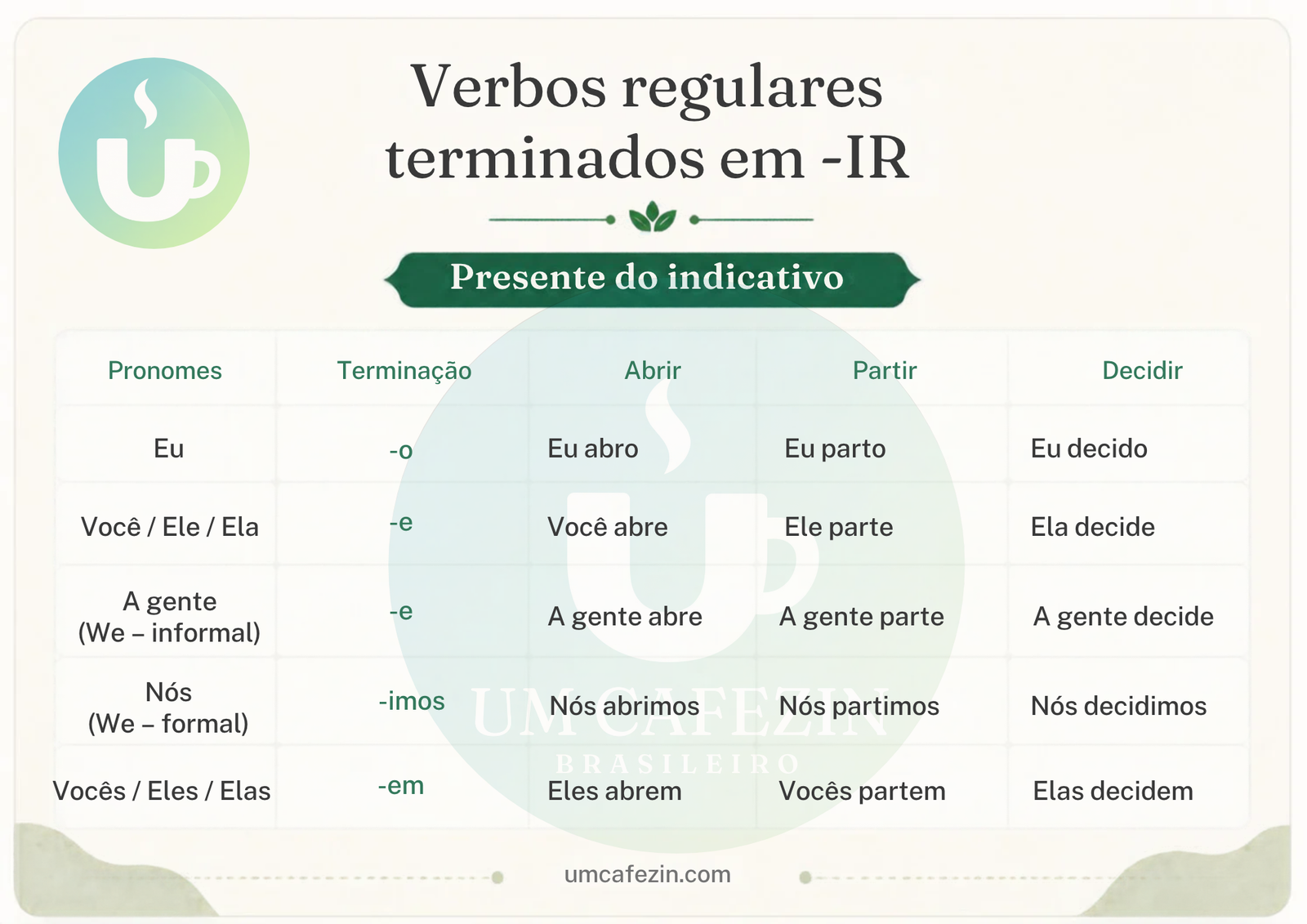
Remember: the endings of regular -IR verbs are -o, -e, -imos, -em. Compare them with -ER verbs (como, come, comemos, comem): the only difference is the “nós” form. With -ER verbs, -emos (comemos); with -IR verbs, -imos (partimos).
Tip: to make a negative sentence, put não before the verb: Eu não desisto. (I don’t give up.) To ask a question, the word order does not change. Only your intonation changes: Você divide o táxi? (Will you share the taxi?) To answer “yes”, repeat the verb: Divido. (Yes, I will.)
The most common regular -IR verbs
These 16 regular -IR verbs come up a lot in conversations. All of them follow the rule in the table.
| Verbo (Verb) | English | Exemplo (Example) |
|---|---|---|
| abrir | to open | O banco abre às dez. (The bank opens at ten.) |
| partir | to leave; to break, to split | Ela parte o pão com a mão. (She breaks the bread with her hand.) |
| decidir | to decide | Os alunos decidem o tema. (The students decide the topic.) |
| assistir (a) | to watch | Eu assisto a séries no celular. (I watch series on my phone.) |
| dividir | to divide, to share | Nós dividimos as tarefas de casa. (We share the housework.) |
| discutir | to discuss, to argue | Vocês discutem o plano hoje? (Are you discussing the plan today?) |
| existir | to exist, there + be | Existem muitas praias bonitas no Brasil. (There are many beautiful beaches in Brazil.) |
| permitir | to allow | O médico permite café? (Does the doctor allow coffee?) |
| insistir (em) | to insist | O vendedor insiste muito. (The salesman insists a lot.) |
| imprimir | to print | A impressora imprime em cores. (The printer prints in color.) |
| admitir | to admit | Eu admito: estou cansado. (I admit it: I’m tired.) |
| desistir (de) | to give up | Ela não desiste dos sonhos. (She doesn’t give up on her dreams.) |
| aplaudir | to clap, to applaud | As crianças aplaudem o palhaço. (The children clap for the clown.) |
| cumprir | to keep, to fulfill | Ele sempre cumpre as promessas. (He always keeps his promises.) |
| garantir | to guarantee | A loja garante a entrega. (The store guarantees the delivery.) |
| curtir (informal) | to enjoy, to like | Você curte samba? (Do you like samba?) |
Careful: many verbs ending in -ir are irregular, for example: ir, vir, pedir (peço), ouvir (ouço), dormir (durmo), sentir (sinto), preferir (prefiro), servir (sirvo), seguir (sigo), subir (ele sobe) and sair (saio). Others change only their spelling with “eu”, to keep the sound, and are still regular: g becomes j (dirigir → dirijo, corrigir → corrijo, exigir → exijo).
Verbs that take a preposition
Some regular -IR verbs need a preposition before the object. See the examples below:
| Verbo + preposição (Verb + preposition) | Exemplo (Example) |
|---|---|
| assistir a | Nós assistimos ao jogo no bar. (We watch the game at the bar.) |
| insistir em | O Rui insiste em cozinhar. (Rui insists on cooking.) |
| desistir de | Eu não desisto de você. (I won’t give up on you.) |
| discutir com | Ela discute com o chefe. (She argues with her boss.) |
Sentences with regular -IR verbs to listen to
Tap the green button to hear each sentence. Use “Modo teste” (test mode) to hide the English and practice.
Part 1 • Opening, leaving and deciding
| Português | English |
|---|---|
| Eu abro a loja às nove. | I open the store at nine. |
| O trem parte às oito. | The train leaves at eight. |
| Você decide amanhã? | Will you decide tomorrow? |
| Nós assistimos à novela juntos. | We watch the soap opera together. |
| A gente divide a conta. | We split the bill. |
| Eles discutem muito. | They argue a lot. |
| Essa loja ainda existe? | Does this store still exist? |
Part 2 • Routine and daily life
| Português | English |
|---|---|
| A escola não permite celular na sala. | The school doesn’t allow cell phones in class. |
| Ela insiste em pagar. | She insists on paying. |
| Eu imprimo os documentos no trabalho. | I print the documents at work. |
| Ele admite o erro. | He admits the mistake. |
| Nós nunca desistimos. | We never give up. |
| O público aplaude no final. | The audience claps at the end. |
| A gente curte música brasileira. | We love Brazilian music. |
Common mistakes with regular -IR verbs
These are the four mistakes learners make most often with regular -IR verbs:
- With “nós”, the ending is -imos, not -emos.
- ❌ Nós partemos amanhã. → ✅ Nós partimos amanhã. (We leave tomorrow.)
- With “eu”, the ending is -o.
- ❌ Eu abre a janela. → ✅ Eu abro a janela. (I open the window.)
- With “eles” and “elas”, the ending is -em, not -im.
- ❌ Eles decidim hoje. → ✅ Eles decidem hoje. (They decide today.)
- With “eu”, g becomes j in verbs like dirigir and corrigir.
- ❌ Eu dirigo devagar. → ✅ Eu dirijo devagar. (I drive slowly.)
Activity 2
Complete the sentences with the verb in the present indicative. The infinitive is in parentheses.
Eu *divido* o quarto com a minha irmã. (dividir)
Você *abre* a porta, por favor? (abrir)
Nós *assistimos* às aulas online. (assistir)
Elas *discutem* o projeto. (discutir)
A gente *decide* depois. (decidir)
O ônibus *parte* da rodoviária. (partir)
Vocês *desistem* fácil? (desistir)
Eu não *permito* isso. (permitir)
Activity 3
Choose the correct option.
Eu ___ a caixa.
- abro
- abre
- abrimos
- abrem
Com eu, a terminação é -o.
Nós ___ às sete.
- partimos
- partemos
- partem
- parte
Nos verbos em -ir, a terminação de nós é -imos, não -emos.
Eles ___ tudo em casa.
- imprimem
- imprimam
- imprimimos
- imprime
Com eles, a terminação é -em.
A gente ___ a pizza.
- divide
- dividimos
- dividem
- divido
Com a gente, o verbo fica igual ao de você, ele e ela.
Qual destes verbos não é regular?
- dormir
- abrir
- partir
- decidir
Dormir é irregular: eu durmo, ele dorme.
Qual é a forma certa de dirigir com eu?
- dirijo
- dirigo
- dirije
- dirijio
Com eu, o g vira j: dirijo.
Você ___ à aula de manhã?
- assiste
- assisto
- assistem
- assistimos
Com você, a terminação é -e.
Qual é a terminação de nós nos verbos regulares em -ir?
- -imos
- -emos
- -amos
- -em
Frequently asked questions
Are all verbs ending in -ir regular?
No. Many verbs ending in -ir are irregular, like ir, vir, pedir, ouvir, dormir, sentir, preferir, servir, seguir, subir and sair. When in doubt, check the conjugation in the Michaelis Online dictionary (in Portuguese).
What is the difference between -er and -ir verbs?
Between regular -ER verbs and regular -IR verbs, only the “nós” form changes in the present indicative: nós comemos (-er) and nós partimos (-ir). The other forms have the same endings: como, come, comem; parto, parte, partem.
Is “nós partimos” present or past?
It can be both. With regular -IR verbs, the “nós” form is the same in the present and in the simple past: “Nós partimos amanhã” (We leave tomorrow) and “Ontem nós partimos cedo” (Yesterday we left early). Words like “amanhã” and “ontem” show the tense.
“Assistir o filme” or “assistir ao filme”?
In standard Portuguese, when it means “to watch”, assistir takes the preposition “a”: “assistir ao filme”. In everyday speech, many Brazilians say “assistir o filme”. In formal writing, use “assistir a”. Careful: assistir does not usually mean “to assist” (to help is ajudar).
How do I say “I am opening” in Portuguese?
Use the verb estar + the verb ending in -indo: “Eu estou abrindo a porta.” (I am opening the door.) With regular -IR verbs, just change -ir to -indo: partir → partindo, decidir → decidindo.
Hora do Cafezinho
Let’s practice regular -IR verbs! Answer out loud or write in your notebook:
- Você divide a casa com alguém? (Do you share your home with anyone?)
- Quem decide o jantar na sua casa? (Who decides what’s for dinner at your home?)
- Você desiste fácil das coisas? (Do you give up on things easily?)
Example: “Eu divido a casa com dois amigos. A gente decide o jantar junto. Eu não desisto fácil!” (I share the house with two friends. We decide on dinner together. I don’t give up easily!)
Worksheet – PDF
Activities with an answer key to print (in Portuguese).