
Regular -ER verbs are the second most common group of verbs in Portuguese: comer, beber, aprender, viver and many others. Once you learn to conjugate regular -ER verbs, you can talk about what you eat, what you drink and what you are learning. (Comer = to eat; beber = to drink; aprender = to learn; viver = to live.)
In this post about regular -ER verbs in the present indicative, you will see the endings, the list of the 16 most common verbs, the most common mistakes, listen to 14 sentences and practice with 24 exercises. Ready?
See how we use regular -ER verbs
- Eu como pão de manhã. (I eat bread in the morning.)
- Você entende português? (Do you understand Portuguese?)
- A Ana vive em Salvador. (Ana lives in Salvador.)
- Nós bebemos café juntos. (We drink coffee together.)
- Eles vendem frutas na feira. (They sell fruit at the street market.)
Activity 1
Drag the words to complete the sentences.
Eu *corro* todas as manhãs.
Você *aprende* rápido.
Ela *escreve* cartas para a avó.
Nós *comemos* juntos no domingo.
Eles *bebem* suco de laranja.
A gente *vende* bolos na feira.
Vocês *recebem* o salário no dia cinco?
O João *responde* as mensagens à noite.
How to conjugate regular -ER verbs in the present indicative
Which present? Here, presente do indicativo (present indicative) is the tense we use for what is happening now, what always happens and facts. (In English, it matches the simple present.)
The rule has two steps. First, remove the -er from the infinitive: comer → com-. Then add the ending for each person:
| Pronome (Pronoun) | Terminação (Ending) | Comer | Exemplo (Example) |
|---|---|---|---|
| Eu (I) | -o | como | Eu como pouco à noite. (I eat little at night.) |
| Você, Ele, Ela (You, He, She) | -e | come | Ela come muito chocolate. (She eats a lot of chocolate.) |
| A gente (We – informal) | -e | come | A gente come em casa. (We eat at home.) |
| Nós (We – formal) | -emos | comemos | Nós comemos às doze. (We eat at twelve.) |
| Vocês, Eles, Elas (You all, They) | -em | comem | Eles comem rápido. (They eat fast.) |
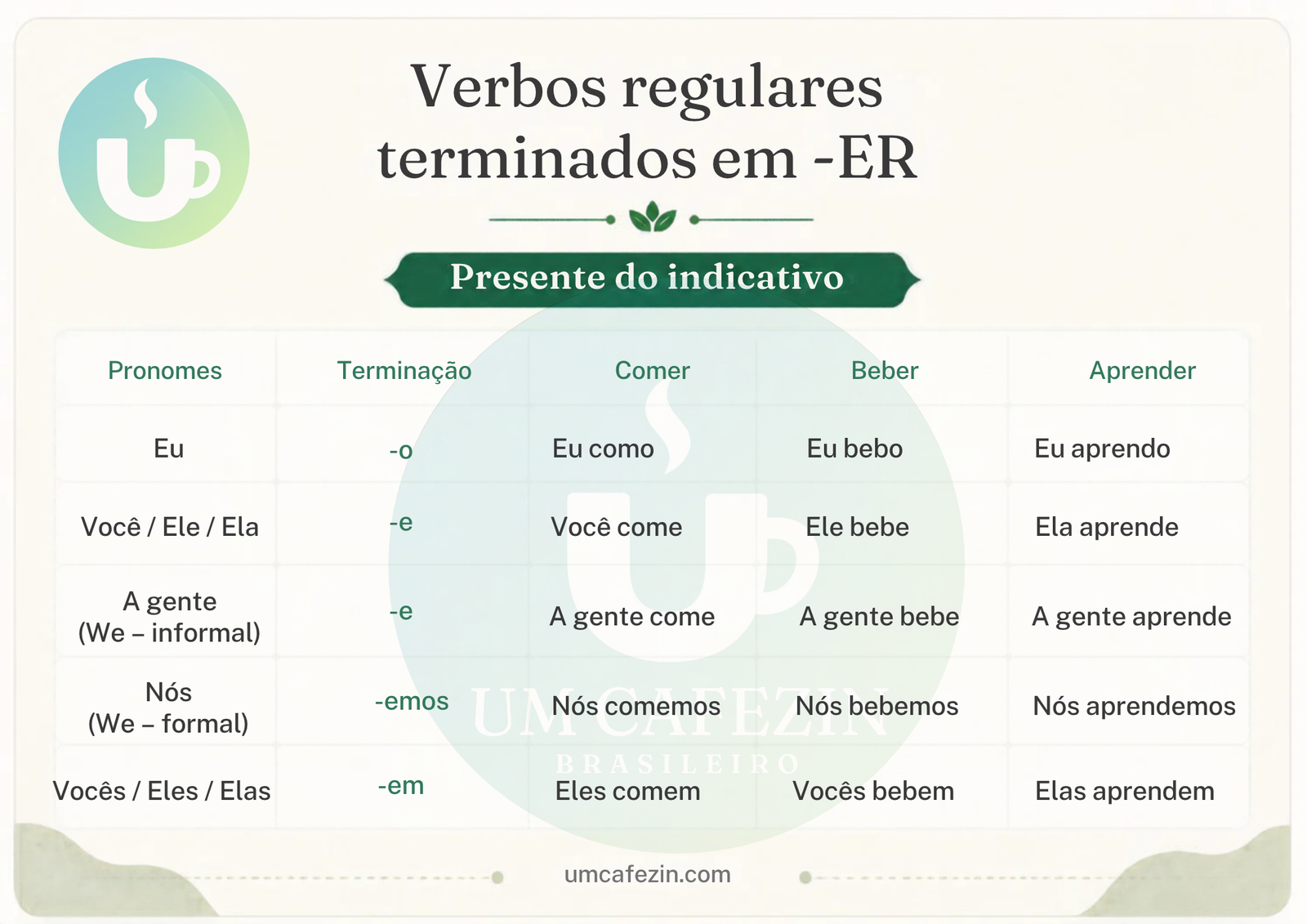
Remember: the endings of regular -ER verbs are -o, -e, -emos, -em. Compare them with -AR verbs: falo, fala, falamos, falam. Only the vowel changes: -a becomes -e (fala → come, falamos → comemos, falam → comem). The “eu” form is the same in both groups: falo, como.
Tip: to make a negative sentence, put não before the verb: Eu não bebo refrigerante. (I don’t drink soda.) To ask a question, the word order does not change. Only your intonation changes: Você come carne? (Do you eat meat?) To answer “yes”, repeat the verb: Como. (Yes, I do.)
The most common regular -ER verbs
These 16 regular -ER verbs come up in conversations every day. All of them follow the rule in the table.
| Verbo (Verb) | English | Exemplo (Example) |
|---|---|---|
| comer | to eat | As crianças comem muita fruta. (The kids eat a lot of fruit.) |
| beber | to drink | Eu bebo café sem açúcar. (I drink coffee without sugar.) |
| viver | to live | Meus avós vivem no campo. (My grandparents live in the countryside.) |
| aprender | to learn | Você aprende com vídeos? (Do you learn with videos?) |
| vender | to sell | Essa loja vende livros usados. (This store sells used books.) |
| correr | to run | O meu cachorro corre muito. (My dog runs a lot.) |
| escrever | to write | Ela escreve para um jornal. (She writes for a newspaper.) |
| receber | to receive, to get | Nós recebemos visitas no Natal. (We have visitors at Christmas.) |
| responder | to answer | Ele nunca responde. (He never answers.) |
| entender | to understand | Os alunos entendem tudo. (The students understand everything.) |
| esquecer | to forget | Eu esqueço nomes com facilidade. (I forget names easily.) |
| dever | must, should; to owe | Você deve descansar. (You should rest.) |
| escolher | to choose | A gente escolhe a sobremesa. (We choose the dessert.) |
| devolver | to return, to give back | Eles devolvem o carro no domingo. (They return the car on Sunday.) |
| prometer | to promise | Eu prometo ligar amanhã. (I promise to call tomorrow.) |
| conhecer | to know, to meet | Vocês conhecem esta praia? (Do you know this beach?) |
Careful: some regular -ER verbs change only their spelling with “eu”, to keep the sound: c becomes ç (conhecer → conheço, esquecer → esqueço) and g becomes j (proteger → protejo). And many verbs ending in -er are irregular: ser, ter, fazer, poder, querer, ver, ler, dizer, trazer, saber and perder (perco).
Verbs that take a preposition
Some regular -ER verbs need a preposition before the object. See the examples below:
| Verbo + preposição (Verb + preposition) | Exemplo (Example) |
|---|---|
| aprender a | Ela aprende a nadar. (She is learning to swim.) |
| depender de | A viagem depende do tempo. (The trip depends on the weather.) |
| entender de | Meu pai entende de carros. (My father knows a lot about cars.) |
| viver de | O Rui vive de música. (Rui makes a living from music.) |
Sentences with regular -ER verbs to listen to
Tap the green button to hear each sentence. Use “Modo teste” (test mode) to hide the English and practice.
Part 1 • Eating, drinking and learning
| Português | English |
|---|---|
| Eu como salada no almoço. | I eat salad for lunch. |
| Você bebe muita água? | Do you drink a lot of water? |
| Ela vive com os avós. | She lives with her grandparents. |
| Nós aprendemos rápido. | We learn fast. |
| A gente vende roupas na internet. | We sell clothes online. |
| Eles correm no parque aos domingos. | They run in the park on Sundays. |
| Meu filho escreve muito bem. | My son writes very well. |
Part 2 • Routine and daily life
| Português | English |
|---|---|
| Vocês recebem muitas mensagens? | Do you get a lot of messages? |
| Eu não entendo essa palavra. | I don’t understand this word. |
| Ela sempre esquece a chave. | She always forgets the key. |
| O professor responde todas as perguntas. | The teacher answers all the questions. |
| Nós devemos pagar a conta hoje. | We must pay the bill today. |
| Você escolhe o filme hoje? | Are you choosing the movie today? |
| Eu devolvo o livro amanhã. | I’ll return the book tomorrow. |
Common mistakes with regular -ER verbs
These are the four mistakes learners make most often with regular -ER verbs:
- With “eu”, the ending is -o.
- ❌ Eu come carne. → ✅ Eu como carne. (I eat meat.)
- With “eles” and “elas”, the ending is -em, not -am.
- ❌ Eles bebam água. → ✅ Eles bebem água. (They drink water.)
- With “nós”, the ending is -emos, not -amos.
- ❌ Nós vivamos aqui. → ✅ Nós vivemos aqui. (We live here.)
- With “eu”, c becomes ç in verbs like conhecer and esquecer.
- ❌ Eu conheco a Bia. → ✅ Eu conheço a Bia. (I know Bia.)
Activity 2
Complete the sentences with the verb in the present indicative. The infinitive is in parentheses.
Eu *bebo* chá à noite. (beber)
Você *vive* sozinho? (viver)
Nós *escrevemos* no caderno. (escrever)
Elas *aprendem* inglês na escola. (aprender)
A gente *come* fora no sábado. (comer)
Meu pai *vende* carros. (vender)
Vocês *entendem* o professor? (entender)
Eu sempre *esqueço* o guarda-chuva. (esquecer)
Activity 3
Choose the correct option.
Eu ___ arroz e feijão.
- como
- come
- comemos
- comem
Com eu, a terminação é -o.
Eles ___ em Lisboa.
- vivem
- vive
- vivam
- vivemos
Nos verbos em -er, a terminação de eles é -em, não -am.
A gente ___ muito nesta aula.
- aprende
- aprendemos
- aprendem
- aprendo
Com a gente, o verbo fica igual ao de você, ele e ela.
Qual é a forma certa?
- Eu conheço.
- Eu conheco.
- Eu conhesso.
- Eu conhece.
Com eu, o c vira ç: conheço.
Qual destes verbos não é regular?
- fazer
- comer
- vender
- beber
Fazer termina em -er, mas é irregular: faço, faz, fazemos, fazem.
Nós ___ no parque.
- corremos
- corramos
- correm
- corre
Com nós, a terminação é -emos.
Você ___ o meu e-mail?
- recebe
- recebo
- recebem
- recebemos
Com você, a terminação é -e.
Qual é a terminação de eles nos verbos regulares em -er?
- -em
- -am
- -emos
- -e
Frequently asked questions
Are all verbs ending in -er regular?
No. Many verbs ending in -er are irregular, like ser, ter, fazer, poder, querer, ver, ler, dizer, trazer, saber and perder. When in doubt, check the conjugation in the Michaelis Online dictionary (in Portuguese).
Are “conheço” and “esqueço” irregular?
No. Conhecer and esquecer are regular -ER verbs. The ç only appears to keep the “s” sound before “o”: “conheco” would be read with a “k” sound. The other forms are normal: conhece, conhecemos, conhecem.
Why do “como” and “come” sound different?
In many -er verbs, the stem vowel changes its sound, but the spelling does not change. In most of Brazil, “eu como” has a closed “o” (like in “avô”), and “ele come” has an open “o” (like in “avó”). The same happens with bebo and bebe. Listen to the sentences with audio to practice.
Is “nós comemos” present or past?
It can be both. With regular -ER verbs, the “nós” form is the same in the present and in the simple past: “Nós comemos arroz todo dia” (We eat rice every day) and “Ontem nós comemos pizza” (Yesterday we ate pizza). Words like “todo dia” and “ontem” show the tense.
How do I say “I am eating” in Portuguese?
Use the verb estar + the verb ending in -endo: “Eu estou comendo.” (I am eating.) With regular -ER verbs, just change -er to -endo: beber → bebendo, escrever → escrevendo.
Hora do Cafezinho
Let’s practice regular -ER verbs! Answer out loud or write in your notebook:
- O que você come no café da manhã? (What do you eat for breakfast?)
- O que você bebe durante o dia? (What do you drink during the day?)
- O que você aprende agora? (What are you learning right now?)
Example: “No café da manhã, eu como pão com manteiga e bebo café. Durante o dia, bebo muita água. Agora, aprendo português e violão.” (For breakfast, I eat bread and butter and drink coffee. During the day, I drink a lot of water. Right now, I’m learning Portuguese and the guitar.)
Worksheet – PDF
Activities with an answer key to print (in Portuguese).