
The verb ficar is one of the most useful verbs in Portuguese, but it confuses many learners. That is because it has several uses and there is no single English translation: it can mean stay, be, get, become or keep. The good news is that the conjugation is easy: eu fico, você fica, nós ficamos, eles ficam. (I stay, you stay, we stay, they stay.)
In this post about the verb ficar in the present indicative, you will see the conjugation, learn its five most common uses, understand the difference between ficar and estar, listen to 14 sentences and practice with 24 exercises. Ready?
See how we use the verb ficar
- Eu fico em casa no domingo. (I stay home on Sundays.)
- O hotel fica perto da praia. (The hotel is near the beach.)
- Ela fica brava com o trânsito. (She gets angry with the traffic.)
- Nós ficamos com o apartamento maior. (We’re taking the bigger apartment.)
- Essa camisa fica ótima em você. (That shirt looks great on you.)
Activity 1
Drag the words to complete the sentences.
Eu *fico* triste com essa música.
O correio *fica* no centro da cidade.
Nós *ficamos* em casa quando chove.
As lojas *ficam* abertas até as dez.
Você *fica* aqui ou vai embora?
A gente *fica* com fome cedo.
Meus amigos *ficam* num hostel.
Eu *fico* com a mesa perto da janela.
How to conjugate the verb ficar in the present indicative
Which present? Here, presente do indicativo (present indicative) is the tense we use for what is happening now, what always happens and facts. (In English, it matches the simple present.)
| Pronome (Pronoun) | Verbo ficar | Exemplo (Example) |
|---|---|---|
| Eu (I) | fico | Eu fico no hotel. (I’m staying at the hotel.) |
| Você, Ele, Ela (You, He, She) | fica | Ela fica feliz. (She gets happy.) |
| A gente (We – informal) | fica | A gente fica aqui. (We stay here.) |
| Nós (We – formal) | ficamos | Nós ficamos com fome. (We get hungry.) |
| Vocês, Eles, Elas (You all, They) | ficam | Elas ficam no Rio. (They are staying in Rio.) |
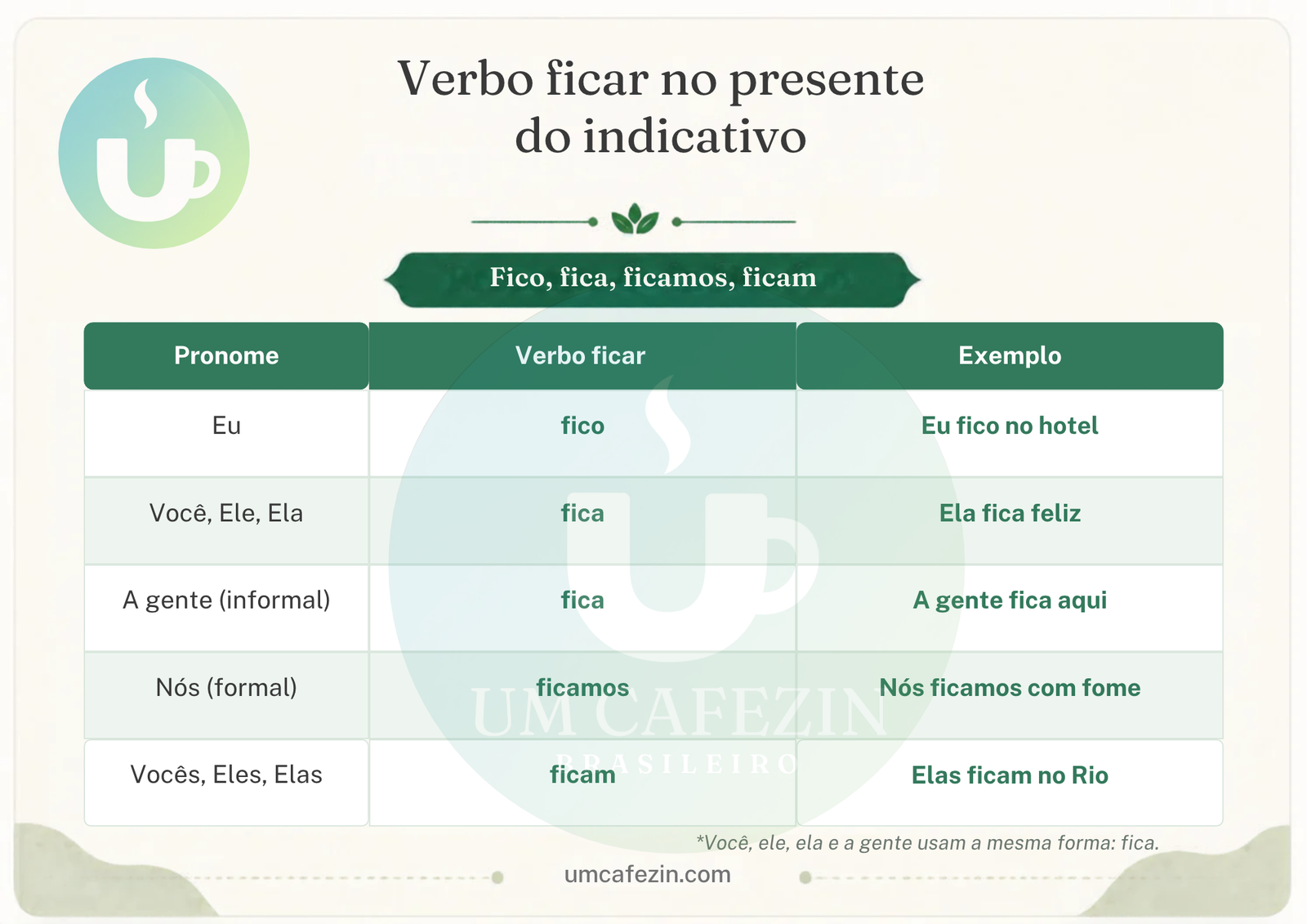
Remember: in the present indicative, the verb ficar is regular. Remove -ar (fic-) and add the endings -o, -a, -amos, -am. Você, ele, ela and a gente all use the same form: fica.
Tip: to make a negative sentence, put não before the verb: Eu não fico nervoso. (I don’t get nervous.) To ask a question, the word order does not change. Only your intonation changes: Você fica para o almoço? (Are you staying for lunch?)
The 5 uses of the verb ficar
This is the part that confuses learners most. Here is each use of the verb ficar with an example and the most common English translation:
| Uso (Use) | Exemplo (Example) | In English |
|---|---|---|
| 1. Staying (not leaving a place) | Hoje eu fico em casa. | stay |
| 2. Location (places that don’t move) | A farmácia fica perto daqui. | be (located) |
| 3. Change of state (ficar + adjective) | Eu fico feliz com a notícia. | get, become |
| 4. Ficar com (choosing, keeping) | Fico com a camiseta azul. | take, keep |
| 5. Ficar bem/mal (clothes, colors, haircuts) | Essa cor fica bem em você. | look good/bad on |
Tip: in a store or a restaurant, “fico com…” is the natural way to choose: Fico com esta. (I’ll take this one.)
Ficar or estar?
The verb ficar and the verb estar can both translate as be, but they are not the same. Compare:
| Estar | Ficar |
|---|---|
| Where a person or thing is right now: Eu estou no centro. (I’m downtown.) | Where a place is: O museu fica no centro. (The museum is downtown.) |
| The state right now: Eu estou nervoso. (I’m nervous.) | The change of state: Eu fico nervoso antes da prova. (I get nervous before the test.) |
Note: for the place where you live, we use morar, not ficar: Eu moro em Curitiba. (I live in Curitiba.) Ficar is for a stay: Eu fico em Curitiba até sexta. (I’m staying in Curitiba until Friday.)
Expressions with the verb ficar
| Expressão (Expression) | Exemplo (Example) |
|---|---|
| Quanto fica? | Quanto fica o pão de queijo? (How much is the cheese bread?) |
| Fica tranquilo! | Fica tranquilo, eu ajudo você. (Don’t worry, I’ll help you.) |
| Fica à vontade. | Entra! Fica à vontade. (Come in! Make yourself at home.) |
| ficar de olho | Eu fico de olho nas crianças. (I keep an eye on the kids.) |
| ficar sabendo | A gente sempre fica sabendo das novidades pelo grupo. (We always find out the news through the group chat.) |
Tip: in “Fica tranquilo!” and “Fica à vontade.”, the verb gives advice or an invitation. In everyday Brazilian Portuguese, for “você”, we use the form fica.
Sentences with the verb ficar to listen to
Tap the green button to hear each sentence with the verb ficar. Use “Modo teste” (test mode) to hide the English and practice.
Part 1 • Staying and location
| Português | English |
|---|---|
| Eu fico no escritório até as seis. | I stay at the office until six. |
| Vocês ficam para o jantar? | Are you staying for dinner? |
| A gente fica mais um pouco. | We’re staying a little longer. |
| A padaria fica na rua de trás. | The bakery is on the street behind. |
| Onde fica o banheiro? | Where is the bathroom? |
| Minha cidade fica no sul do Brasil. | My city is in the south of Brazil. |
| Eu fico com sono depois do almoço. | I get sleepy after lunch. |
Part 2 • Changes, choices and expressions
| Português | English |
|---|---|
| O céu fica escuro às seis. | The sky gets dark at six. |
| Meus pais ficam preocupados quando eu viajo. | My parents get worried when I travel. |
| Eu fico com o bolo de chocolate. | I’ll have the chocolate cake. |
| Esse vestido fica lindo em você. | That dress looks beautiful on you. |
| Quanto fica tudo? | How much is everything? |
| Fica à vontade! | Make yourself at home! |
| Eu não fico nervosa em entrevistas. | I don’t get nervous in interviews. |
Common mistakes with the verb ficar
- Ficar only translates “get” when an adjective follows.
- ❌ Eu fico uma mensagem. → ✅ Eu recebo uma mensagem. (I get a message.)
- For the place where you live, use morar.
- ❌ Eu fico em Recife há cinco anos. → ✅ Eu moro em Recife há cinco anos. (I’ve lived in Recife for five years.)
- For the state right now, use estar. Ficar shows the change.
- ❌ Agora eu fico cansado. → ✅ Agora eu estou cansado. (I’m tired now.)
- With “a gente”, use fica.
- ❌ A gente ficamos em casa. → ✅ A gente fica em casa. (We stay home.)
Activity 2
Complete the sentences with the verb ficar in the present indicative.
Eu *fico* cansada depois do trabalho. (ficar)
A estação de metrô *fica* a dois quarteirões. (ficar)
Nós *ficamos* na casa dos meus avós no Natal. (ficar)
Os alunos *ficam* quietos durante a prova. (ficar)
Esses óculos *ficam* ótimos em você. (ficar)
Eu não *fico* com raiva facilmente. (ficar)
Você *fica* em casa no sábado? (ficar)
Quanto *fica* o café com pão de queijo? (ficar)
Activity 3
Choose the correct option.
Onde ___ a biblioteca?
- fica
- ficam
- fico
- ficamos
Qual frase mostra uma mudança de estado?
- Eu fico nervoso antes da prova.
- Eu fico em casa hoje.
- O banco fica na esquina.
- Fico com esta blusa.
Ficar + adjetivo mostra uma mudança: a pessoa fica nervosa.
Como dizemos “I’ll take this one” numa loja?
- Fico com esta.
- Fico esta.
- Fico de esta.
- Fico para esta.
Para escolher algo numa loja, usamos ficar com.
Qual frase está correta?
- A gente fica aqui.
- A gente ficamos aqui.
- A gente fico aqui.
- A gente ficam aqui.
Com “a gente”, usamos a mesma forma de “ele” e “ela”: fica.
Como dizemos “I live in Recife”?
- Eu moro em Recife.
- Eu fico em Recife.
- Eu fico de Recife.
- Eu sou em Recife.
Para o lugar onde você mora, usamos morar. Ficar é para uma estadia.
“Quanto fica?” quer dizer:
- How much is it?
- Where is it?
- How long are you staying?
- How are you?
Elas ___ cansadas depois da aula.
- ficam
- fica
- fico
- ficamos
Qual frase fala do estado de agora?
- Eu estou cansado agora.
- Eu fico cansado depois do jogo.
- Eu fico cansado às vezes.
- Eu ficamos cansado.
Para o estado de agora, usamos estar. Ficar mostra a mudança.
Frequently asked questions
Is the verb ficar regular?
In the present indicative, yes: fico, fica, ficamos, ficam. In other tenses, only the spelling changes a little to keep the sound: in the preterite, for example, we write “eu fiquei”. You can look up the verb in the Michaelis Online dictionary (in Portuguese).
What is the difference between ficar and estar?
Estar talks about the moment: where someone is and how they are right now. The verb ficar talks about fixed places (O banco fica na esquina), staying (Fico em casa) and changes (Fico com fome às onze). In speech, you will also hear “O banco é na esquina”.
What does “Quanto fica?” mean?
It is a common way to ask the total price, especially when you are paying: “Quanto fica tudo?” (How much is everything?) We also say “Quanto custa?” and “Quanto é?”.
What does “ficar com alguém” mean?
It depends on the sentence. “Fico com a minha avó no sábado” means you spend time with her. But among young people, “ficar com alguém” also means a casual, no-commitment romance. The context shows the meaning.
How do I say “I get tired” and “I get hungry”?
Use the verb ficar + adjective: “Eu fico cansado.” With fome, sede, sono and frio, we use ficar com: “Eu fico com fome.” (I get hungry.)
Hora do Cafezinho
Let’s practice the verb ficar! Answer out loud or write in your notebook: Onde fica a sua casa? Você fica em casa no fim de semana? Quando você fica feliz? (Where is your house? Do you stay home on the weekend? When do you get happy?) Example: “A minha casa fica perto do metrô. No sábado, eu fico em casa. Eu fico feliz quando vejo os meus amigos.” (My house is near the subway. On Saturday, I stay home. I get happy when I see my friends.)
Worksheet – PDF
Activities with an answer key to print (in Portuguese).